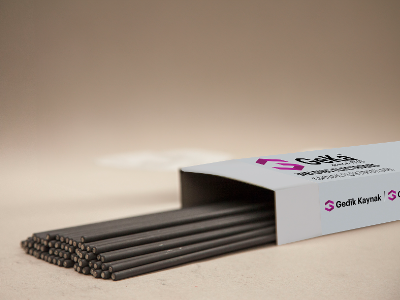
Things You Should Know While Choosing Casting Electrodes
Things You Should Know While Choosing Casting Electrodes
Strong Welds with Low Risk of Cracks Using the Right Electrode
Why Is Electrode Selection Critical in Casting Welding?
Casting materials are among the most difficult materials to weld due to their high carbon content, brittle structure, and heterogeneous microstructure. Incorrect electrode selection can lead to serious problems such as post-weld cracking, breakage, hardening, and loss of machinability.
Therefore, choosing the right electrode for casting welding is a fundamental factor for welding success.
1. Correctly Identify the Type of Casting Material
Before selecting an electrode, the type of casting material to be welded must be clearly identified:
- Gray cast iron
- Ductile (spheroidal graphite) iron
- Malleable (tempered) iron
- White cast iron
Since each type of casting has different mechanical properties, using a single type of electrode is not appropriate.
2. Prefer Nickel-Based Electrodes
Nickel-based electrodes are the most common and reliable choice in casting welding.
- Pure nickel electrodes:
- High machinability
- Low risk of cracking
- Ideal for precise and repair welds
- Nickel-iron (Ni-Fe) electrodes:
- Higher mechanical strength
- Suitable for parts subjected to heavy loads
The correct alloy should be selected according to the purpose of the application.
3. Consider Post-Weld Machinability Requirements
If machining will be performed after welding, the electrode selection should be suitable for this purpose.
- Pure nickel electrodes → high machinability
- High-iron electrodes → harder structure
This criterion must be taken into account for repair and maintenance applications that require machinability.
4. Electrode Selection to Minimize Cracking Risk
The greatest risk in casting materials is cracks that form during cooling. Therefore, electrodes should be chosen that:
- Have low hydrogen content
- Feature designs that control heat input
- Use alloys that provide elastic and tough weld metal
5. Welding Method and Application Conditions
In casting welding, the following are generally applied:
- Electrode (MMA) welding
- Low amperage
- Short welds (step welding)
The electrode must be suitable for these working conditions.
6. Consider Preheating and Cooling Conditions
Electrode selection should also take into account the preheating method to be applied:
- Preheated welding
- Cold welding (without preheating, controlled)
Some electrodes are more suitable for use with low preheating.
7. Standards and Application Safety
The selected casting electrode should:
- Comply with EN, ISO, or AWS standards
- Be suitable for the welding position
- Have clear application instructions
These criteria are of great importance for industrial safety and quality.
Reliable Solutions in Casting Welding with Gedik Welding
Gedik Welding offers nickel-based casting electrodes developed for casting repair and manufacturing applications, providing welds that are durable, machinable, and have a low risk of cracking. With technical support and proper product guidance, it helps achieve reliable results in casting welding.
Conclusion
Selecting a casting electrode is not just a choice of consumable; it is a strategic decision that directly affects post-weld performance. By choosing an electrode that matches the type of casting, machinability requirements, and working conditions, strong, reliable, and long-lasting welded joints can be achieved.