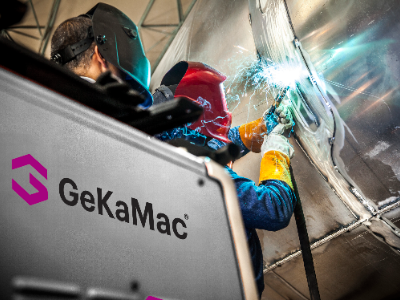
What is a Gas Shielded Welding Machine?
What is a Gas Shielded Welding Machine?
A gas metal arc welding machine is an essential piece of equipment used to join metal materials under a protective gas atmosphere. Operating with the MIG (Metal Inert Gas) and MAG (Metal Active Gas) methods, these machines are widely used in industrial manufacturing thanks to their speed, efficiency, and low spatter performance.
Gas-shielded welding machines use a semi-automatic system in which the consumable wire is continuously fed to the torch. The shielding gas isolates the molten weld pool from oxygen, and moisture in the atmosphere, ensuring a clean, smooth, and strong weld seam.
Working Principle of Gas Shielded Welding Machines
Gas shielded welding machines convert the electrical energy they receive from the network into a controlled welding current. Then:
1. The wire is fed from the wire feed unit to the torch.
2. The shielding gas is distributed from the torch to the welding area.
3. The electric arc formed between the wire and the base material melts the metal.
4. The molten metal pool cools under the shielding gas, forming the weld bead.
This process offers the operator advantages such as high welding speed, stable arc, low heat input, and reduced cleaning requirements.
The Difference Between MIG and MAG
When referring to gas shielded welding machines, we discuss two fundamental methods:
MIG Welding (Metal Inert Gas)
• Inert gas (argon, helium) is used.
• It is suitable for non-reactive materials such as stainless steel, aluminium and copper alloys.
• The weld quality is high.
MAG Welding (Metal Active Gas)
• Active gas (CO₂ or argon–CO₂ mixture) is used.
• It is the most common method for carbon steels and structural steels.
• Production speed is high, and the cost is low.
Basic Components of a Gas Shielded Welding Machine
A gas shielded welding system consists of the following parts:
• Welding power source (inverter or transformer type)
• Wire feed unit
• Welding torch
• Gas cylinder and regulator
• Grounding clamp and cables
• Control panel
• Consumables (welding wire, nozzle, contact tip, etc.)
Modern inverter based models have become the preferred choice for businesses, offering more precise arc control and energy efficiency.
Advantages of Gas Shielded Welding Machines
Gas shielded welding machines stand out in industrial production with the following benefits:
• High welding speed → Ideal for mass production
• Low spatter rate → Cleaner welds, less grinding
• High-quality and uniform weld appearance
• Superior performance on thin sheets
• Compatibility with automation and robotic applications
• Easy to learn operation
• Long uninterrupted welding capability
For these reasons, it is the most widely used welding method in the automotive, metal furniture, shipbuilding, steel construction, machine manufacturing, and white goods industries.
Where are Gas Shielded Welding Machines Used?
Gas shielded welding machines are used in a wide range of industrial applications:
• Automotive and related industries
• Shipbuilding and heavy industry
• Steel construction
• Metal furniture production
• Pipe and profile manufacturing
• Thin sheet metal and stainless steel work
• Workshop production and maintenance-repair work
• Robotic welding lines
Its compatibility with both manual and robotic applications gives this method a strategic position in production lines.
How to Choose the Right Gas Shielded Welding Machine?
The following criteria should be considered when selecting a machine:
• Current range and duty cycle
• Suitable power for material thickness
• Wire feed quality and stability
• Gas type and area of use
• Inverter or transformer preference
• Portability requirement
• Energy efficiency
• Consumable compatibility
• Service network and spare part availability
A correctly selected gas welding machine provides long-term advantages to businesses by increasing both production quality and energy savings.