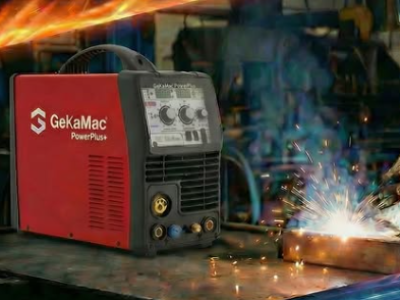
What is a Welding Machine?
What is a Welding Machine?
Welding machines are industrial equipment that permanently join metals or certain special alloys using heat, electric arcs and, when necessary, pressure. In today's manufacturing industry, they are central to production in countless areas such as automotive, shipbuilding, defence, pressure vessels, construction and pipelines.
In its simplest terms, a welding machine converts the electrical energy it receives from the mains into a controlled welding current. This current creates an arc between the electrode and the workpiece, and the resulting high temperature melts and joins the metal.
Basic Components of a Welding Machine
Understanding a welding machine is easier when looking at its main components:
- Power Unit (Welding Power Source)
Converts AC mains electricity into the appropriate current and voltage required for welding. These can be broadly classified into traditional transformer-based types and modern inverter-based machines. - Cables and Connectors
Transmit welding current from the power unit to the electrode and the workpiece. Using cables of the correct cross-section is critical for both safety and performance. - Electrode Holder or Torch
Varies depending on the welding method.- MMA (Shielded Metal Arc Welding): Electrode holder
- MIG/MAG: Welding torch with wire feed system
- TIG: Torch with tungsten electrode
- Ground Clamp
Completes the welding circuit. A solid and clean connection to the workpiece is essential for arc stability. - Control Panel
The section where parameters such as current, voltage, wire speed, and gas flow are adjusted. In modern machines, it is often supported by digital displays and preset programs.
Operating Principle
The basic operating principle of a welding machine can be summarized in three stages:
1. Conversion of Electrical Energy
The energy drawn from the mains is converted into a suitable welding current by the machine’s internal power-electronics components (transformer, diodes, IGBTs, etc.).
2. Arc Formation
When the electrode briefly touches the workpiece and is then lifted, an electric arc forms between them. The temperature in the arc zone can reach 5,000–20,000 °C.
3. Metal Joining
The high temperature melts the base material and, if required, the filler metal. As the molten area cools, a weld seam is created. Depending on the welding method, this process may occur under shielding gas or under the protective slag of a coated electrode.
Welding Machine Types
Today, the most used types of welding machines are:
1. MMA (Shielded Metal Arc Welding) Machines
- The most well-known and traditional welding method.
- The electrode consists of a consumable filler metal and a flux coating.
- Frequently preferred in heavy industry, construction sites, and maintenance–repair work.
- Can be used even in windy outdoor environments.
- Equipment cost is low, and portable models offer advantages in field applications.
2. MIG/MAG Welding Machines
• These are semi-automatic or automatic welding systems where the wire electrode is continuously fed.
- As shielding gas:
- o Inert gases (e.g. argon, helium) for MIG,
- o Active gases (e.g. CO₂ or mixtures) for MAG.
- • Offers high welding speed and production efficiency.
- • Excels in automotive, mass production lines, thin sheet metal fabrication and robotic welding applications.
3. TIG (Tungsten Inert Gas) Welding Machines
• A non-consumable tungsten electrode is used.
• The shielding gas is usually argon.
• Provides high weld quality and an aesthetic appearance.
• Preferred for critical materials such as stainless steel, aluminium, and nickel alloys.
• Workmanship is slower but precision and quality are at the highest level.
4. Plasma Cutting and Special Process Machines
• These are systems that cut metals at high-speed using a plasma arc.
• Some multi-purpose systems may have both welding and cutting functions.
• They are suitable for fast, clean and precise cutting of thick materials.
Inverter Technology: Modern Welding Machines
Today, inverter technology welding machines offer significant advantages over classic heavy transformer machines:
• More compact and lightweight design
• Higher energy efficiency
• Improved arc stability
• Precise current control and digital display
• Combination of different welding modes in a single unit (such as MMA+MIG/MAG+TIG)
This has enabled more flexible use in both professional workshops and mobile service teams.
Areas of Usage
Welding machines are encountered in almost all metal manufacturing processes today:
• Automotive and related industries
• Shipbuilding and shipyards
• Pressure vessels, boilers and pipelines
• Steel construction and heavy industry
• Machine manufacturing
• Maintenance, repair and assembly work
• Artistic metalwork and workshop applications
The welding method, machine power and automation level required differ for each sector. Therefore, selecting the right machine is considered the heart of production.
Safety and Ergonomics
Working with welding machines also carries risks such as exposure to high temperatures, electricity, UV radiation and fumes. Therefore:
• Personal protective equipment (welding mask, gloves, apron, work boots) must be used,
• Machine grounding and cable insulation must be checked regularly,
• The work area must be well ventilated,
• Operators must be trained and certified.
A properly selected, well-maintained welding machine that complies with safety standards is a fundamental element of both efficient and safe production.
2. What You Need to Know When Choosing a Welding Machine
Purchasing a welding machine is not just about answering the question, ‘How many amps?’ The welding method you will use, the type of material, the working environment, the operator's experience, and your production goals should be decisive factors in your choice. An incorrectly selected welding machine can:
• Causing frequent breakdowns that halt production,
• Reducing weld quality,
• Increasing energy costs,
• Tiring operators and leading to dissatisfaction.
Below, you will find the main points to consider when selecting a welding machine, step by step.
1. First, Identify Your Needs
Providing clear answers to the following questions is the first step in making the right choice:
• Which welding method will you use? (MMA, MIG/MAG, TIG, plasma, etc.)
• What materials will you be working with? (black sheet metal, stainless steel, aluminium, castings, etc.)
• What is the typical material thickness?
• What is the production type?
o Fixed production in the workshop
o Field/assembly work
o Mass production line
• How long is the welding time per day?
o Intermittent maintenance work
o Intensive shift production
Your answers to these questions will determine both the power and technical specifications of the machine.
2. Selection Based on Welding Method
MMA Machines
• Ideal for use on site, at construction sites, and for maintenance and repair work.
• Offers advantages in windy environments or where gas shielding is difficult.
• Relatively low investment cost.
• Offers a wide range of applications with different electrode types (rutile, basic, cellulose, etc.).
MIG/MAG Machines
• It is the most preferred solution when serial production and high speed are required.
• It has a low spatter rate in thin sheet metal welding, and the weld appearance is aesthetically pleasing.
• It has become standard in robotic welding applications.
• With suitable gas and wire combinations, it is possible to weld carbon steel, stainless steel, and special alloys.
TIG Machines
• It excels in applications where the highest stitch quality and aesthetic appearance are sought.
• It is the ideal solution for thin-section materials such as stainless steel, aluminium or titanium.
• The risk of distortion can be reduced as the heat input is more controlled.
• It is preferred for jobs where the work rate is relatively low but quality expectations are high.
Whether the machine you choose will focus on only one of these methods or whether you want a multi-process machine is an important factor in your investment decision.
3. Current Value and Duty Cycle (Operating Time)
Two values frequently seen in technical catalogues are of critical importance:
• Maximum source current (A)
• Duty cycle (e.g. 200 A at 60%)
The duty cycle indicates how many minutes a machine can operate continuously at a specific current within a 10-minute period. For example:
• 200 A at 60%:
Welding can be performed at 200 A for 6 minutes out of 10 minutes; it is recommended that the machine be allowed to rest for 4 minutes.
In businesses with intensive production, the higher the duty cycle value, the more suitable the machine is for production. For a machine that will only be used for intermittent maintenance work, this value may not be as critical.
4. Network and Energy Infrastructure
When selecting a welding machine, you must consider your business's electrical infrastructure:
• Will it be single-phase (220 V) or three-phase (380 V)?
• Is the mains voltage stable, or is the fluctuation rate high?
• Is generator compatibility required for field use?
• Is energy cost critical for your business?
Modern inverter welding machines offer advantages over traditional transformer-based machines, such as:
• Lower energy consumption,
• Wider input voltage tolerance,
• Smoother arc characteristics.
This translates to both savings in energy costs and a more stable welding process.
5. Portability and Working Environment
The answer to the question ‘Where will I be welding?’ is also decisive when selecting a machine:
• Will you only be working at a fixed station within the workshop?
• Will you be going to hard-to-reach locations such as high-rise construction sites, ship decks, or refineries?
• Do you have assembly projects that require frequent relocation?
In this case:
• The weight of the machine,
• The carrying handle or wheeled chassis structure,
• Cable and hose lengths
come to the fore. Inverter-equipped, lightweight and compact machines provide significant ergonomics in the field.
6. User Interface and Digital Features
How operators use the machine is also a selection criterion. Especially in workshops where multiple people work:
• A simple and understandable control panel,
• Clearly readable digital displays,
• Pre-set programmes (such as synergic MIG/MAG),
• Memory functions (saving frequently used settings)
reduce both workplace accidents and incorrect parameter usage. This directly translates into improved quality, speed, and efficiency.
7. Auxiliary Equipment and Accessories
A welding machine alone is not sufficient; the entire system must be considered:
• Wire feed units,
• Cooling units (air or water-cooled torches),
• Compatible torches and electrode holders,
• Gas regulators and hoses,
• Transport trolleys, additional cables
When selecting a machine, it is important to ensure that all of this equipment is compatible, reliable and durable. The availability of spare parts and service support also play an important role in the selection process.