What Is Hard facing Welding?
What Is Hard facing Welding?
A Long-Lasting Solution Against Wear
Industrial machinery and equipment used in production are exposed to harsh conditions such as wear, impact, friction, and high temperatures. Over time, these effects lead to component losses and increased maintenance costs. Hard facing welding is an effective and cost-efficient welding method developed to address these challenges.
In this article, we explain what hard facing welding is, its purpose, and the advantages it offers.
What Is Hard facing Welding?
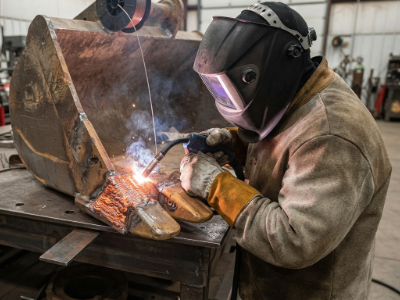
Hard facing welding is a process in which worn or wear-prone surfaces are overlaid with a welding metal that has high hardness and a special alloy composition. The objective is not to change the base material, but to improve surface properties and extend the service life of the component.
This method is applied both to protect new parts and to restore worn components for reuse.
Where Is Hard facing Welding Used?
- Mining and quarries
- Cement plants and power generation facilities
- Agricultural and construction machinery
- Crushers and conveyor systems
- Valves, pumps, and shaft surfaces
Objectives of Hard facing Welding
- Increasing resistance to wear
- Reducing the effects of impact and friction
- Lowering the frequency of part replacement
- Reducing maintenance and downtime costs
What Are the Advantages of Hard facing Welding?
1. Increases Wear Resistance
Hard facing alloys provide high resistance against abrasion, erosion, and metal-to-metal friction.
2. Extends Component Service Life
Worn surfaces are protected or restored, allowing components to be used safely for a longer period of time.
3. Provides Cost Advantages
Compared to manufacturing new parts, hard facing applications offer a more economical solution for businesses.
4. Offers Application Flexibility
Hard facing welding can be applied using:
- Electrodes
- Flux-cored wires
- TIG / MIG methods
and can be adapted to different operating conditions.
5. Customizable Performance
Depending on operating conditions, suitable filler materials can be selected by targeting:
- High hardness
- Impact resistance
- Heat resistance
Key Considerations in Hard facing Welding
- Selection of the correct hard facing alloy
- Compatibility between the base metal and the filler metal
- Requirement for preheating and controlled cooling
- Control of crack risk after welding
Incorrect applications may lead to cracking and failure, even if hardness is increased.
Difference Between Hard facing Welding and Repair Welding
| Feature | Hard facing Welding | Repair Welding |
|---|---|---|
| Objective | Wear resistance | Restoring geometry |
| Hardness | High | Moderate |
| Application | Protection & strengthening | Damage repair |
| Material Structure | Special alloys | Standard filler metals |
Conclusion
Hard facing welding is a long-lasting, durable, and cost-effective solution for equipment exposed to heavy operating conditions. When applied with the correct filler material and appropriate welding method, it significantly increases production efficiency.
As Gedik, we continue to add value to businesses through our welding solutions tailored to different industrial needs and our technical expertise in hard facing applications.