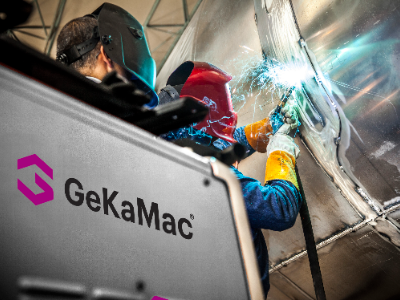
What is MIG/MAG Welding?
What is MIG/MAG Welding?
MIG/MAG welding is an arc welding method performed using a continuously fed welding wire and shielding gas. During the welding process, the wire electrode continuously advances into the weld pool and melts, joining the base metals.
MIG and MAG welding methods basically operate on the same principle; the difference lies in the type of shielding gas used.
- MIG (Metal Inert Gas): Inert gases such as argon are used.
- MAG (Metal Active Gas): Active gases such as CO₂ or a mixture of argon + CO₂ are used.
This method is one of the most widely used welding techniques in industry due to its high speed and high-quality weld seams.
How Does MIG/MAG Welding Work?
The process of MIG/MAG welding proceeds as follows:
- The welding machine continuously feeds the wire electrode.
- An electric arc forms between the wire and the workpiece.
- The wire electrode melts, forming the weld pool.
- The shielding gas isolates the weld pool from the atmosphere.
This process ensures smooth, clean, and high-strength weld seams.
Difference Between MIG and MAG Welding
| Feature | MIG Welding | MAG Welding |
|---|---|---|
| Gas Used | Inert (Argon, Helium) | Active (CO₂, Ar+CO₂) |
| Material Type | Aluminum, Stainless Steel | Carbon and Alloy Steels |
| Weld Appearance | Cleaner and more aesthetic | Higher penetration |
| Area of Usage | Precision and thin work | Heavy industry and mass production |
Advantages of MIG/MAG Welding
- High welding speed
- Continuous operation thanks to the wire feed
- Suitable for automation and robotic systems
- Low spatter and smooth weld appearance
- Adaptable to different materials and thicknesses
These advantages make MIG/MAG welding ideal for mass production.
Where are MIG/MAG Welding used?
MIG/MAG welding has a very wide range of applications:
- Automotive and automotive sub-industry
- Steel construction and manufacturing
- Pressure vessels and tank production
- Pipe and profile welding
- Machinery and equipment manufacturing
It is frequently preferred in industrial applications that require high efficiency.
Points to Consider in MIG/MAG Welding
For successful MIG/MAG welding:
- Select the correct wire diameter and type
- Set the appropriate shielding gas and gas flow rate
- Correctly determine current and voltage parameters
- Control the torch angle and distance
Incorrect settings can lead to quality problems such as spatter, porosity, and insufficient penetration.
Which Materials Can Be Welded with MIG/MAG Welding?
- Carbon steels
- Low-alloy steels
- Stainless steels
- Aluminum and aluminum alloys
Choosing the appropriate wire and gas for the material directly affects welding performance.
Strong Performance with Gedik Welding in MIG/MAG Applications
Gedik Welding provides reliable solutions in industrial production with its high-performance welding machines, welding wires, and technical support services designed for MIG/MAG welding applications. Thanks to stable arc performance and efficient systems, it ensures high-quality and repeatable welding results.
Conclusion
MIG/MAG welding is a modern welding method that combines speed, quality, and efficiency. When applied with the right equipment, suitable consumables, and correct parameters, it produces durable and high-strength welded joints.