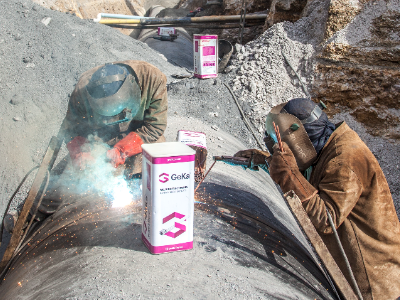
What is Pipe Welding?
What is Pipe Welding?
Pipe welding is the process of joining pipes that carry liquids, gases, or steam in a leak-proof and durable manner using welding techniques. It is critically important for the safe operation of pipelines in energy, petrochemical, construction, infrastructure, and process facilities.
Since welded pipes operate under high pressure and temperature, pipe welding requires greater precision and technical expertise compared to standard welding applications.
The Importance of Pipe Welding
Welds in piping systems:
- Directly affect system safety
- Determine the risk of leaks and explosions
- Ensure the long-term operation of the facility
Therefore, using the correct welding method, appropriate welding consumables, and controlled application is of vital importance in pipe welding.
Most Common Pipe Welding Methods
Electrode (MMA) Welding
- Commonly used in field applications
- Suitable for outdoor conditions
- Particularly preferred for root pass welding
Frequently used in maintenance, repair, and installation work.
TIG Welding
- Provides high weld quality and precision
- Ideal for thin-walled pipes
- Preferred for stainless steel and alloy pipes
Commonly used for root pass welding in critical lines.
MIG/MAG Welding
- Offers high speed and efficiency
- Effective for thick-walled pipes
- Suitable for mass production and workshop environments
Frequently used for filler and cover passes.
Orbital Welding
- Provides automatic and repeatable welding
- Minimizes human error
- Ideal for lines requiring hygiene and precision
Preferred in food, pharmaceutical, and semiconductor facilities.
Welding Positions Used in Pipe Welding
Position information is critical in pipe welding:
- 1G / PA: Flat position
- 2G / PC: Horizontal position
- 5G: Fixed pipe – horizontal axis
- 6G: Fixed pipe – inclined (most difficult position)
Especially 5G and 6G positions are important criteria for welder qualification.
Key Considerations in Pipe Welding
For successful pipe welding:
- Pipe ends should be properly prepared (beveling, chamfering)
- Root gap and alignment must be correctly set
- Appropriate electrode or filler wire should be selected
- Heat input should be applied in a controlled manner
- Post-weld inspections must be conducted
These steps significantly reduce the risk of cracks and leaks.
Where is Pipe Welding Used?
Pipe welding plays a critical role in many industries:
- Oil and natural gas pipelines
- Power plants
- Chemical and petrochemical facilities
- Heating, cooling, and air conditioning systems
- Industrial process lines
In these areas, weld quality is directly related to operational safety.
Reliable Solutions in Pipe Welding with Gedik Welding
Gedik Welding provides industrial-standard solutions for pipe welding applications with high-performance welding machines, wires, and electrodes. Thanks to its technical expertise and product variety, it supports achieving optimal welding performance for different pipe diameters and materials.
Conclusion
Pipe welding is a critical application that requires high safety, strength, and leak-proof performance. With the correct welding method, appropriate consumables, and experienced application, it is possible to create long-lasting and reliable piping systems.